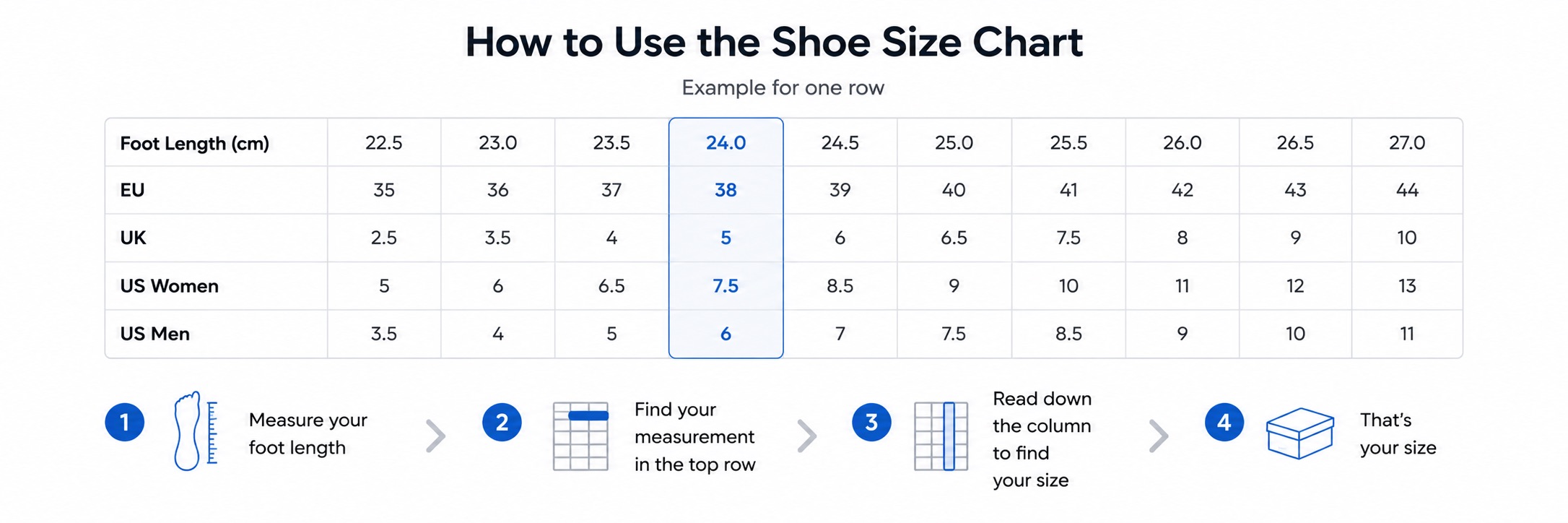
A shoe size chart has one main job: to convert foot length into the sizing systems you actually see in stores. Most confusion starts when people skip the measurement step and jump straight to EU or US labels. The stable reference point is your foot length in centimetres, not the number printed inside an old pair.
Start with your measurement
Before you compare any sizes, measure your foot length. If you have not done that yet, open the guide on how to measure foot length first. Centimetres make it much easier to move between EU, UK and US systems without guessing.
How to read the chart
Find the row or range that matches your foot length. Then read across the table to see the equivalent EU, UK and US numbers. The chart is not trying to predict every model perfectly. It gives you a stable base that makes the next comparison easier.
Where mistakes happen
A common mistake is relying only on your old EU size. Another is forgetting that different types of shoes fit differently. Slim loafers, running shoes and winter boots can feel very different even when the base size looks the same. That is why it helps to combine the universal chart with the brand size database.
When the universal chart is enough
If you need a quick baseline and do not yet know which brand table to trust, the universal chart is the right starting point. It narrows the choice before you move to a specific label or store. Use the Unisizer shoe size chart as that first checkpoint.
How to read the chart without confusion
Think of the chart as a conversion system, not as a random set of labels. Your calmest anchor is foot length in centimetres. From that number you can move into EU, UK and US columns. If you start from a familiar foreign size instead of real measurements, the risk of error gets higher, especially with brands that use their own fit logic.
Why shoe type still matters
The same foot length can feel different in trainers, formal shoes, hiking footwear or winter boots. Some pairs need a closer fit, others need more room for socks and movement. That is why the universal chart should be followed by a look at brand-specific size tables whenever possible.
Practical order of action
- Measure your foot length in centimetres.
- Find the matching row in the shoe size chart.
- Check whether the brand runs narrow, roomy or unusually structured.
- Only then make the final size decision for the pair you want.